Are Amish people Jewish? It’s an honest question — and if you’ve watched a horse-drawn buggy clip-clop through Holmes County, Ohio, past men in broad-brimmed hats and women in plain dresses and head coverings, you might genuinely wonder. The short answer is no: the Amish are Christians, not Jewish. But the reasons for the confusion are interesting, and worth unpacking with respect.
The Short Answer: The Amish Are Anabaptist Christians
The Amish belong to a Christian tradition called Anabaptism, which emerged during the Protestant Reformation in 16th-century Switzerland. The name means “re-baptizer” — early Anabaptists insisted that baptism should be a conscious adult choice, not an infant ritual, and were persecuted by both Catholics and other Protestants for it.
In 1693, a Swiss bishop named Jakob Ammann led a division within the Swiss Anabaptist (Mennonite) movement over questions of discipline and separation from the world. His followers became known as the Amish. They brought their faith to America in the 1700s, seeking the religious freedom Pennsylvania — and later Ohio — offered.
Today, the Amish number more than 380,000 across North America, with the densest settlements in Ohio, Pennsylvania, and Indiana. Each local church district follows its own Ordnung — unwritten rules governing everything from buggy styles to phone use — which is why Amish practices vary noticeably from one community to the next.
Why Do People Get Confused?
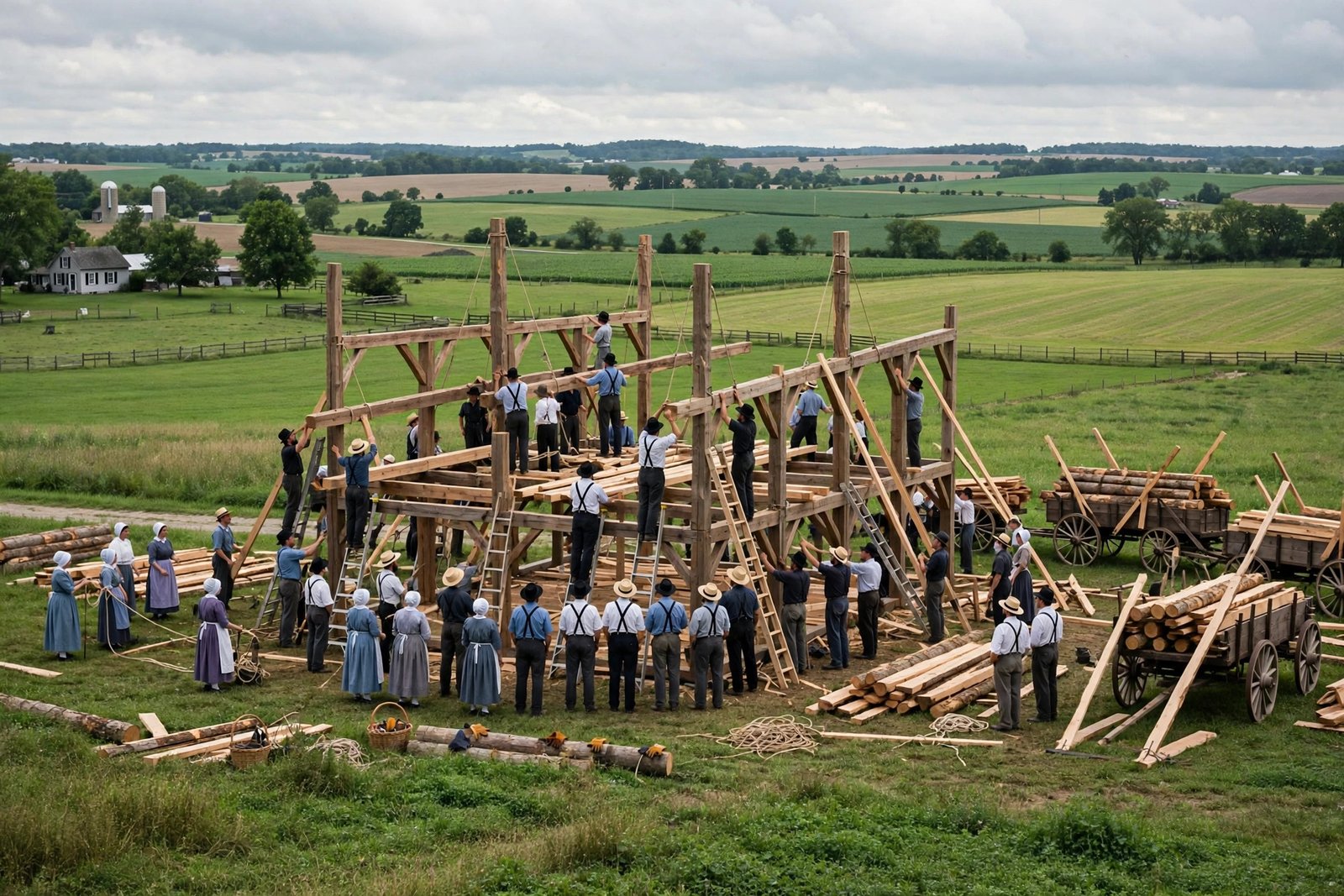
The mix-up is understandable. To an outsider, Amish and some Orthodox Jewish communities share visible similarities:
- Distinctive plain dress — both groups dress modestly and distinctively, setting themselves apart from mainstream fashion.
- Close-knit, separate communities — both maintain strong communal boundaries and prioritize life within the group.
- Traditional ways of life — both resist aspects of modern culture in favor of long-held customs.
- A Germanic language — most Amish speak Pennsylvania Dutch (a German dialect) at home; Yiddish, spoken in many Hasidic communities, is also Germanic. The similar sound adds to the confusion.
- Emphasis on family and faith — large families, faith-centered daily rhythms, and a wariness of assimilation.
These are surface parallels between two very different religions, not signs of a shared faith.
Are Amish People Jewish? Key Differences at a Glance
- Religion: The Amish are Christians; Judaism is a separate, older Abrahamic faith.
- Scripture: The Amish read the Christian Bible — Old and New Testaments. Jewish scripture is the Tanakh (Hebrew Bible); the New Testament is not part of it.
- Jesus: Central to Amish faith as savior and Lord. In Judaism, Jesus is not regarded as divine or as the messiah.
- Worship: Amish gather for Sunday services in homes and barns, singing German hymns a cappella. Jewish worship centers on the synagogue, the Torah, and the Sabbath (Saturday).
- Dietary law: Judaism observes kosher laws; the Amish have no equivalent dietary code.
The Amish in Ohio
Ohio is home to the largest Amish population of any U.S. state, centered on Holmes County in the northeast. The settlement around Millersburg and Berlin is the largest Amish community in the world, and its farms, furniture shops, and bakeries draw millions of respectful visitors each year. For trip-planning tips, check out our guide to Ohio’s Amish Country.
Visiting Amish Country Respectfully
If the question “are Amish people Jewish” brought you here out of curiosity about a trip, a few courtesies go a long way:
- Don’t photograph people’s faces. Many Amish consider posed photos a violation of humility — when in doubt, photograph barns and landscapes, not faces.
- Drive carefully. Buggies share rural roads; give them room and patience.
- Ask before entering property. Farms are homes and workplaces, not attractions.
- Buy local. Furniture, quilts, cheese, and baked goods from Amish shops support the community directly.
So: are Amish people Jewish? No — they’re Anabaptist Christians with a 500-year history of their own. But asking the question is how understanding starts, and in Ohio’s Amish Country, there’s plenty to understand.
