Do Amish believe in Jesus? Yes — completely and centrally. The Amish are Christians, and Jesus Christ stands at the very heart of their faith. If anything, their belief shapes daily life more visibly than in most Christian traditions, because for the Amish, faith isn’t just what you profess on Sunday — it’s how you farm, dress, work, and treat your neighbor on Monday.
Do Amish Believe in Jesus? Jesus at the Center of Amish Faith
The Amish are Anabaptist Christians, part of a tradition born in the 16th-century Reformation. Like all Christians, they believe Jesus is the Son of God, that he died for humanity’s sins and rose again, and that salvation comes through him. The Bible — Old and New Testaments — is their authority, read in German in most congregations.
This isn’t a vague cultural Christianity. Amish children memorize scripture and catechism-like questions from the Christenpflicht, and church members are expected to measure their conduct — in business dealings, in marriage, in conflict — directly against Jesus’s example.

What Belief Looks Like: The Sermon on the Mount
Where the Amish stand out isn’t whether they believe in Jesus but how literally they take his teachings. The Sermon on the Mount (Matthew 5–7) functions as their practical constitution:
- Nonresistance: “Turn the other cheek” is lived out as pacifism — the Amish do not serve in the military and avoid lawsuits.
- Humility: The German concept of Gelassenheit — yieldedness, letting go of ego — shapes everything from plain dress to the refusal to be photographed.
- Community over self: Wealth is shared through barn raisings, mutual aid, and caring for widows and orphans within the church.
- Separation from the world: Limiting technology and outside entanglements is, to the Amish, obedience to Christ’s call to be “in the world but not of it.”
The Dordrecht Confession
Amish beliefs are summarized in the Dordrecht Confession of Faith, adopted in 1632. Its 18 articles cover God, creation, the fall, redemption through Christ, baptism, the church, communion, foot washing, marriage, and nonresistance. Conservative Amish groups still read it at baptismal and communion services — a direct link to their spiritual ancestors.
Adult Baptism: Choosing Christ for Yourself
Following the Anabaptist conviction that started it all, the Amish baptize adults, not infants — typically between ages 18 and 22. Young people experience Rumspringa, a period of greater freedom in the teenage years, and then decide whether to be baptized and join the church. Most choose to join, making baptism a deliberate, personal commitment to Christ and the community.
How the Amish Worship
Amish Sunday services look nothing like a typical American church service — and that’s intentional:
- No church buildings (in most groups) — services rotate among members’ homes and barns.
- Three-hour services in Pennsylvania Dutch and High German.
- A cappella singing from the Ausbund, a hymnal dating to the 1500s — no instruments.
- Ministers chosen by lot, unsalaried, serving for life alongside their farming or trade work.
What the Amish Don’t Emphasize
Visitors sometimes expect evangelistic preaching, but the Amish live by the saying often attributed to St. Francis: “Preach the gospel always; use words when necessary.” They rarely proselytize. Their witness is the community itself — the farm, the family, the plain coat. Theological debate takes a back seat to obedience: the question is less “what do you believe about Jesus?” than “does your life look like his teachings?”
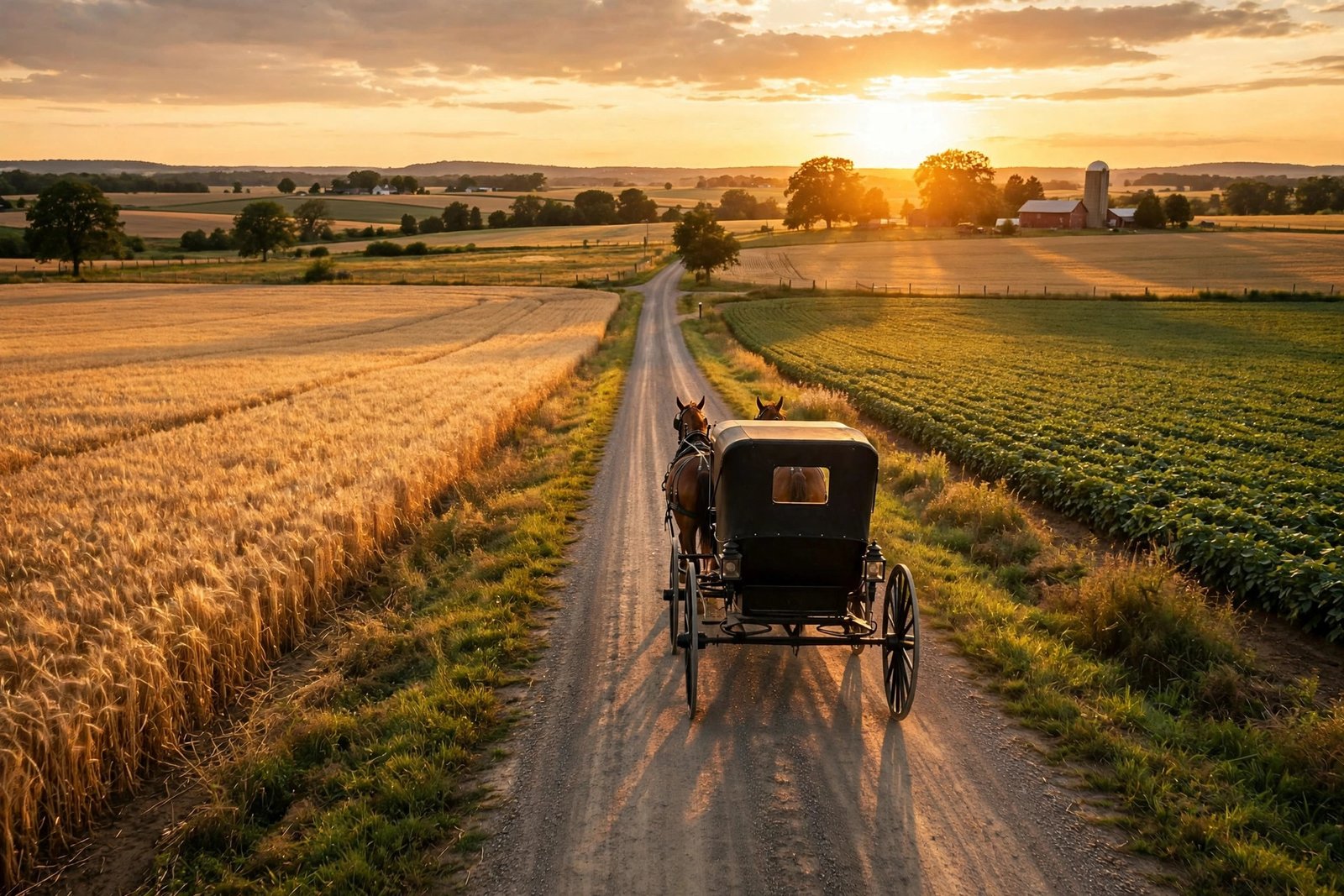
So do Amish believe in Jesus? Yes — as Lord, savior, and the pattern for every part of life. In Ohio’s Amish Country, you won’t find that belief argued on billboards. You’ll find it lived out in the fields. Spring and fall are especially lovely times to explore Holmes County’s back roads, when the fields are at their most beautiful.
