How dark can your window tint legally be in Ohio? The short version of the Ohio window tint law: your front side windows must let at least 50% of light through, and how dark your rear windows can go depends on the type of vehicle you drive. Get it wrong and you’re looking at a misdemeanor ticket — Ohio police can and do enforce tint during traffic stops.
Here’s the complete breakdown of the Ohio window tint law, based on Ohio Revised Code § 4513.241 and the Ohio Administrative Code rules that set the actual percentages.
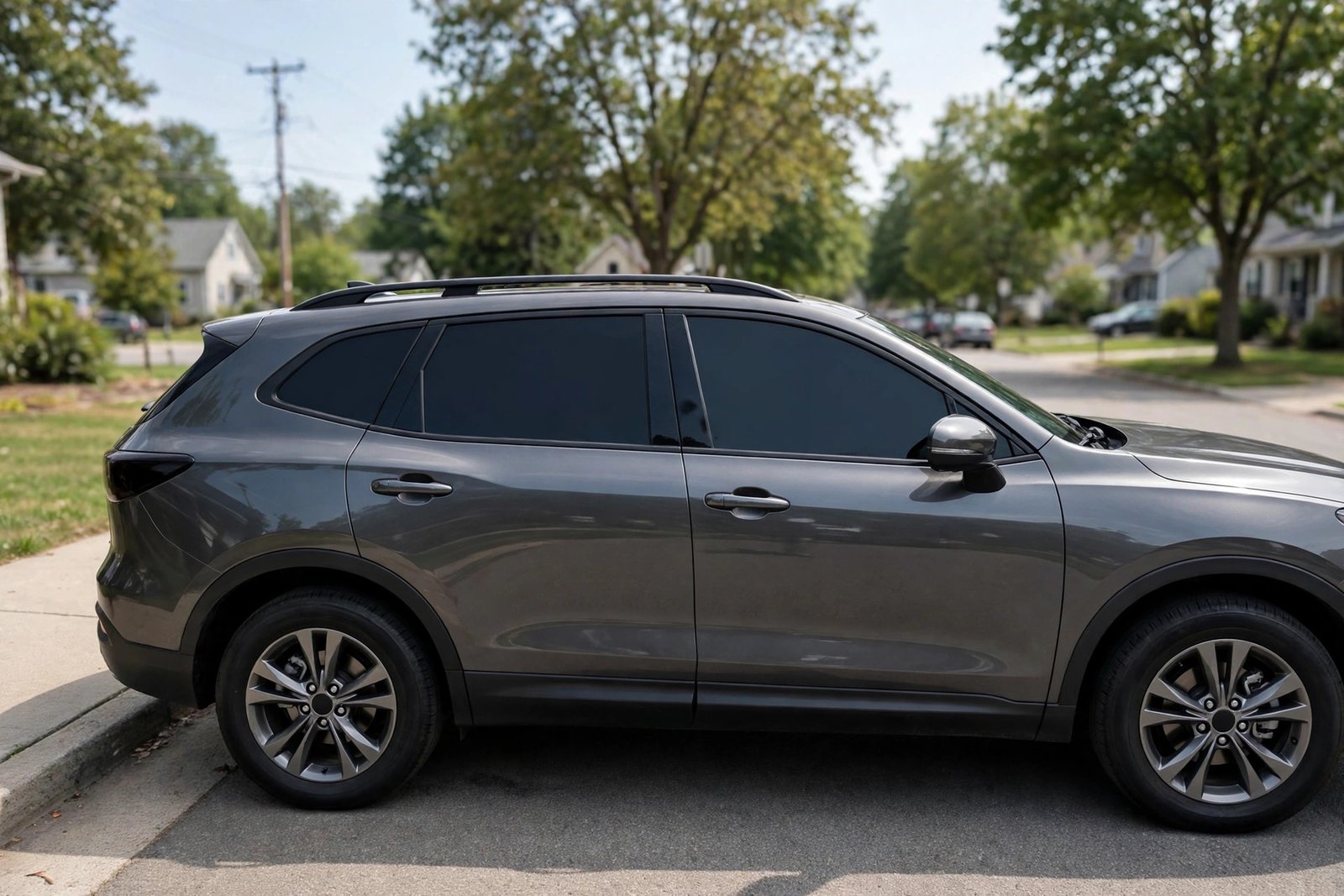
Ohio Window Tint Rules at a Glance
| Window | Minimum light allowed through (VLT) | Notes |
|---|---|---|
| Windshield | 70% (±3%) | Only above the AS-1 line or the top 5 inches, whichever is closer to the top; no red or yellow tint |
| Front side windows | 50% (±3%) | Applies to all vehicles; no red or yellow tint |
| Rear side windows (sedans) | 50% (±3%) | Passenger cars: same 50% rule all around |
| Rear side + rear window (SUVs, vans, trucks) | Any darkness | Multi-purpose vehicles may go as dark as they like behind the front seats |
VLT means “visible light transmission” — the percentage of light that passes through the glass. A 50% film lets half the light through; a 20% film is much darker. Note the ±3% tolerance built into the Ohio window tint law, and remember that factory glass is already slightly tinted, so a “50%” film applied over factory glass will meter darker than 50%.
The Details Most Guides Get Wrong
Sedans vs. SUVs: different rear-window rules
This is the detail that trips people up. For passenger cars (sedans, coupes), the 50% minimum applies to every window except the windshield strip. But for multi-purpose vehicles — SUVs, vans, and trucks — windows behind the front seats can be any darkness, including limo tint. The front side windows still must meet 50% on every vehicle type.
Reflective and mirrored tint is restricted
Ohio limits how reflective your tint can be — highly mirrored or metallic films that reflect excessive light are not allowed on any window. Stick with standard non-reflective film.
Every tinted window needs a compliance sticker
Ohio requires a permanent label on each tinted window showing the manufacturer’s name and the light-transmission level, placed in the lower-left corner of the window as viewed from outside. A reputable installer provides these automatically — and the film manufacturer must certify the film meets Ohio standards. Keep your installer’s compliance paperwork in the car.
Dual mirrors required with dark rear tint
If your rear window is tinted, your vehicle must have outside mirrors on both the left and right sides.
Medical Exemptions Under the Ohio Window Tint Law
Ohio provides a limited medical exemption process for drivers with conditions that cause unusual sensitivity to light (such as lupus, albinism, or certain photosensitivity disorders). The process generally requires a licensed physician’s written statement or prescription documenting the condition, submitted to the Ohio Bureau of Motor Vehicles (BMV) — see our guide to Ohio BMV registration — with the documentation kept in the vehicle.
Even with an exemption, tinting the full windshield is still not permitted. Because public guidance on this process is thin, contact the BMV directly before assuming you qualify.
Penalties: What a Tint Ticket Costs in Ohio
Violating the Ohio window tint law is a minor misdemeanor under O.R.C. § 4513.241(K) — for both drivers and, separately, dealers who sell non-compliant vehicles. In practice:
- Fine: typically around $100–$150, varying by court
- Fix-it orders: many courts effectively require you to remove or replace the non-compliant film
- Repeat offenses can bring higher penalties
Tint is also a common add-on citation: an officer who stops you for another reason can ticket the tint too. And out-of-state drivers aren’t automatically safe — Ohio officers can enforce the tint law on vehicles passing through.
How to Stay Legal Under the Ohio Window Tint Law
Follow these steps to stay on the right side of the Ohio window tint law:
- Choose a certified installer who knows Ohio’s 50% front / any-rear-for-SUVs split and provides compliance stickers.
- Go lighter than the limit on front windows — factory glass eats a few percentage points, so a 50% film can meter at 45–47%.
- Keep documentation — the installer’s certification and any medical exemption paperwork — in the vehicle.
- Never tint below the AS-1 line on the windshield.
Bottom line: the Ohio window tint law is straightforward — 50% on front windows, a 70% windshield strip, and any darkness behind the front seats of SUVs, vans, and trucks. Meter the film before it’s installed and keep your paperwork in the car.
Ohio Window Tint Law: Frequently Asked Questions
Is 20% tint legal on front windows in Ohio?
No. Front side windows must allow at least 50% (±3%) of light through on every vehicle type. 20% tint on front windows will get you a ticket.
Can I have 5% (limo) tint on my SUV in Ohio?
On the rear side windows and rear window of an SUV, van, or truck — yes, any darkness is allowed behind the front seats. The front side windows must still be 50% or lighter, and you’ll need dual side mirrors.
Is it legal to tint my entire windshield in Ohio?
No. Only the strip above the AS-1 line (or the top 5 inches) may be tinted, and that strip must still allow 70% of light through. Full-windshield tint is illegal even with a medical exemption.
Can police pull me over just for window tint in Ohio?
Yes. Illegal tint is a primary equipment violation — an officer who reasonably believes your tint is too dark can stop you for the tint alone, and it is frequently cited alongside other violations.
This article is for informational purposes only and is not legal advice. The Ohio window tint law is set by O.R.C. § 4513.241 and Ohio Administrative Code Chapter 4501-41 — check the current text at codes.ohio.gov if you’re planning an install.
