What is the difference between Mennonites and Amish people? They’re often confused — both are plain-dressing Anabaptist Christians with roots in 16th-century Europe — but they split over 300 years ago and live quite differently today. Here’s the clear breakdown.
What is the difference between Mennonites and Amish people? The Short Answer
Both groups descend from the Anabaptist movement, and both were shaped by the teachings of Menno Simons (Mennonites) and Jakob Ammann (Amish). The Amish broke away from the Mennonites in 1693 because Ammann wanted stricter church discipline — including shunning excommunicated members. That stricter stance never really softened, and it’s why the Amish live more separately from modern life than most Mennonites do.
Technology: The Biggest Visible Difference
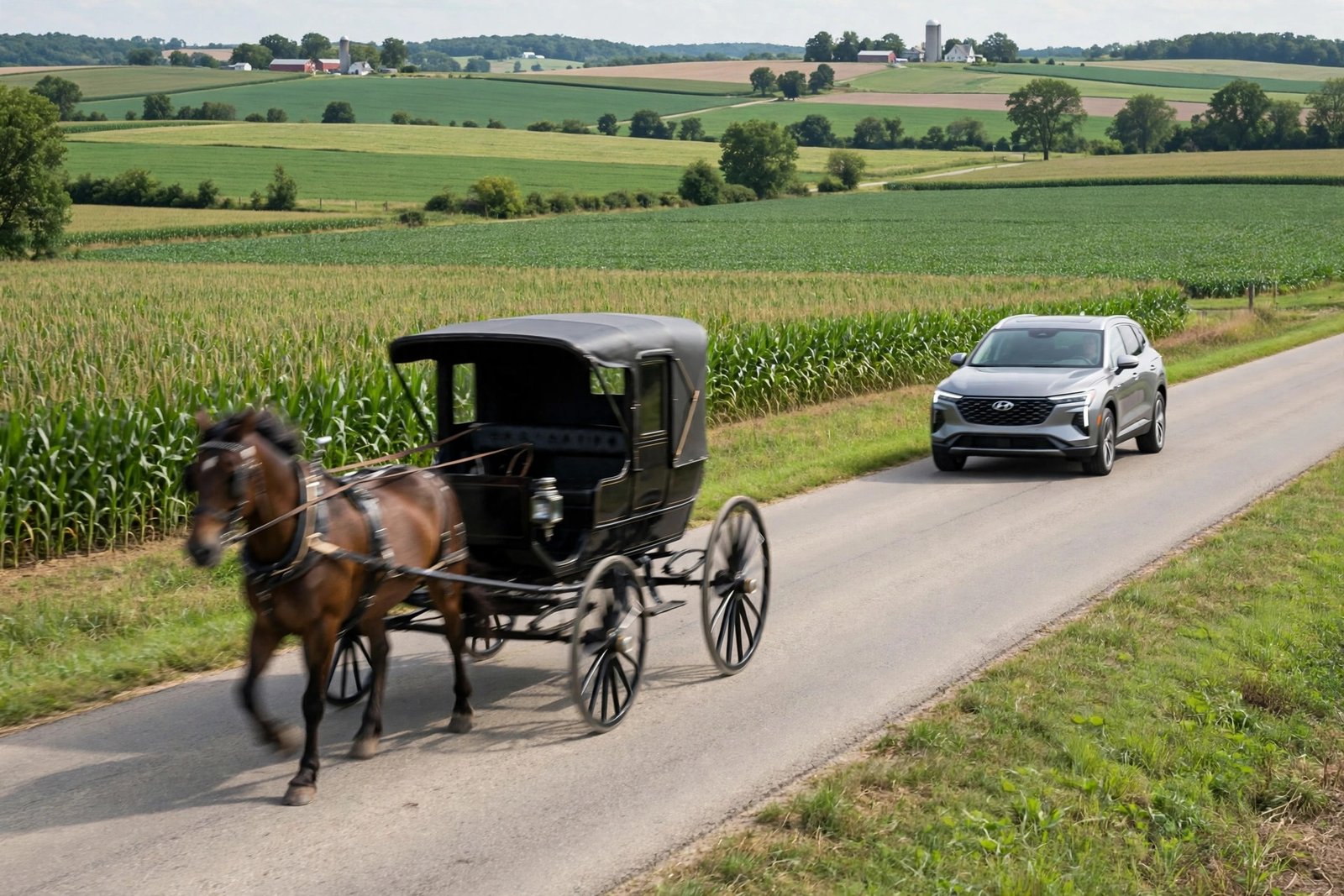
This is what most people notice first. Old Order Amish generally avoid cars, grid electricity, and phones in the home — you’ll see them in horse-drawn buggies across Ohio’s Holmes County. Most Mennonites, by contrast, drive cars, use electricity, and work in ordinary modern jobs; you’d often pass a Mennonite on the street without noticing anything distinctive beyond modest dress.
There are exceptions on both sides: some Amish affiliations allow more technology, and some conservative Mennonite groups live nearly as plainly as the Amish. But as a rule of thumb — buggy means Amish; car with plain-dressed driver could be either, but is more likely Mennonite.
Beliefs: More Alike Than Different
Theologically, the two groups are close cousins. Both practice:
- Adult baptism — church membership is a conscious choice made in the late teens or twenties, not at infancy
- Nonresistance — refusal of military service and a commitment to nonviolence
- Separation from the world — the degree varies enormously, but the principle is shared
- Community mutual aid — barn raisings, shared labor, and care for members in need
Where they differ is discipline: the Amish practice of shunning (Meidung) — socially avoiding members who leave or break the rules — remains a defining Amish practice that most Mennonite churches abandoned or softened long ago. For a deeper look, see what Amish people believe.
Dress and Daily Life
Amish dress is the more uniform of the two: solid colors, no patterns, prayer coverings for women, beards without mustaches for married men. Mennonite dress varies widely — conservative Mennonite women may wear head coverings and long dresses, while mainstream Mennonites dress indistinguishably from anyone else. Amish children typically attend one-room schoolhouses through eighth grade; Mennonite children may attend public or Mennonite schools at any level, including college.
Visiting Amish and Mennonite Communities Respectfully
If you visit Holmes or Wayne County, you’ll meet both groups — sometimes in the same shop. A few etiquette notes go a long way: many Amish prefer not to be photographed (ask first, and accept no gracefully), drive patiently around buggies, and treat Sunday as a true day of rest — most Amish-owned businesses are closed. Mennonite-owned shops generally keep normal hours, which is one practical way visitors notice the difference.
Lehman’s in Kidron is the classic stop for understanding both cultures at once: a sprawling non-electric goods store founded to serve Amish families, now beloved by homesteaders and the simply curious. It’s Mennonite-owned, Amish-shopped, and a perfect illustration of how the two communities overlap in daily life.

Ohio: Home to Both
Ohio has the largest Amish population of any state — over 80,000, centered on Holmes County — and a large Mennonite presence as well, particularly in Wayne County and around Kidron, home to Lehman’s (the famous non-electric goods store that serves both communities). If you visit Amish Country, you’ll encounter both groups, sometimes shopping in the same stores.
Quick Comparison
- Cars: Amish — no (buggies); Mennonites — usually yes
- Electricity: Amish — generally no; Mennonites — usually yes
- Dress: Amish — uniformly plain; Mennonites — varies from plain to ordinary
- Schooling: Amish — through 8th grade; Mennonites — no set limit
- Shunning: Amish — practiced; Mennonites — mostly not
- Shared roots: both Anabaptist, both trace to the 1500s
So: cousins, not twins. Same grandparents, very different household rules.
