The Ohio state flag is the only state flag in America that isn’t a rectangle. Shaped like a swallowtail pennant — properly called a burgee — Ohio’s flag stands out in every lineup of state flags, and every stripe, star, and triangle on it means something specific. Here’s the full story: the design, the symbolism, and the history.
What Does the Ohio State Flag Look Like?
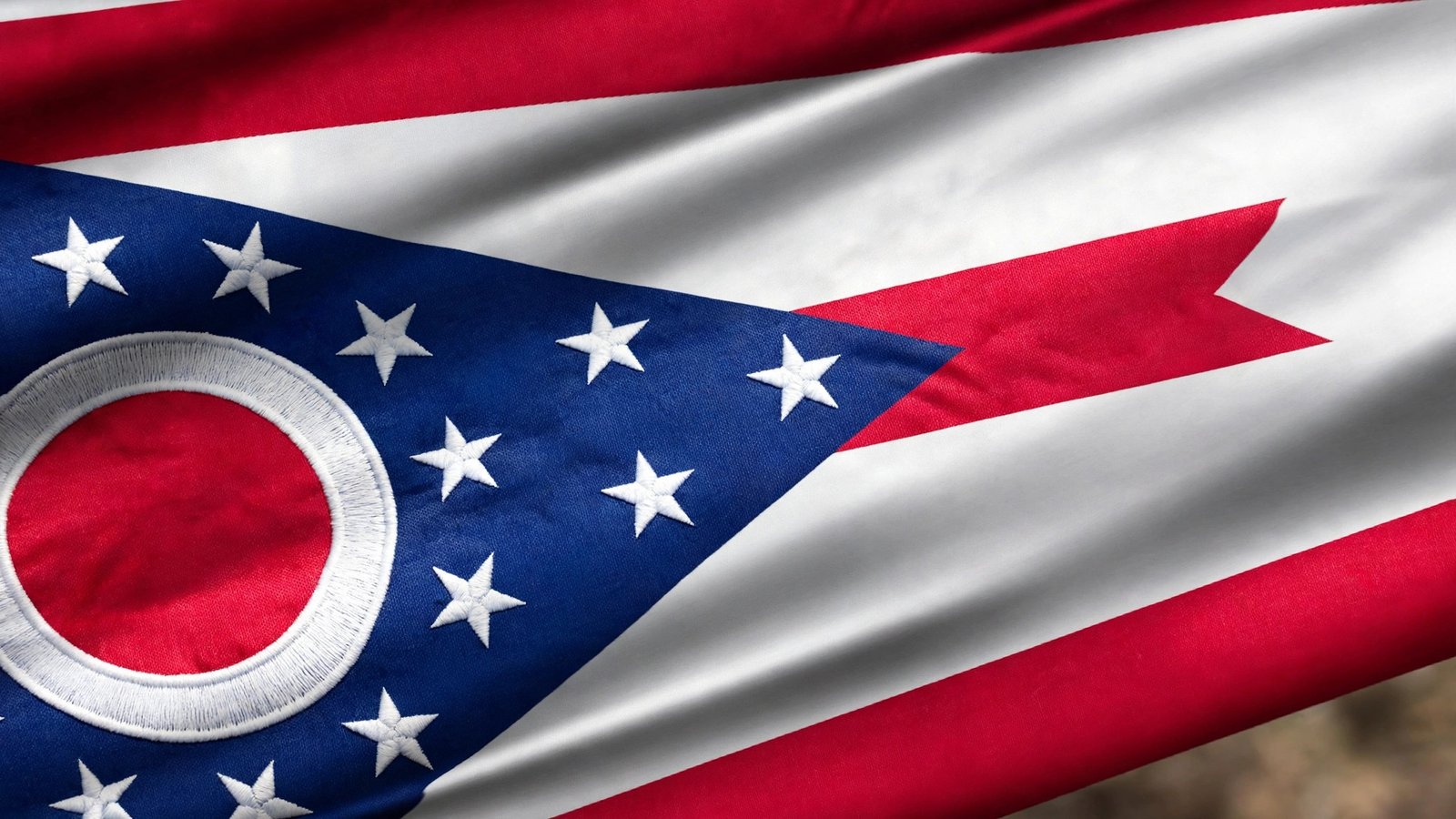
The Ohio state flag has three red and two white horizontal stripes. At the staff end (the left side) sits a blue triangular field, with one point resting at the center of the middle red stripe. Inside the triangle are 17 white five-pointed stars grouped around a red disc with a white circular “O” around it.
Because the fly end tapers to a swallowtail point, the flag can be hung or flown in any orientation without looking wrong — one reason its designer, Cleveland architect John Eisenmann, chose the pennant shape for the 1901 Pan-American Exposition in Buffalo, New York.
Ohio State Flag Meaning: Every Symbol Explained
Nothing on the Ohio state flag is decorative. Per the Ohio Secretary of State’s own explainer:
- The white circle with a red center forms the letter “O” — the first letter of Ohio. It also nods to the buckeye, Ohio’s famous state tree nut.
- The 17 stars: 13 stars are grouped around the circle for the original 13 states; 4 more stars were added to bring the total to 17, because Ohio was the 17th state admitted to the Union (1803).
- The blue triangle represents Ohio’s hills and valleys, as seen on the state seal.
- The red and white stripes represent Ohio’s roads and waterways — the transportation routes that built the state. The five stripes are also read as the five states carved out of the Northwest Territory.
Ohio State Flag History: From 1901 to 1902
Ohio went nearly a century without an official flag. Eisenmann designed the burgee to fly over the Ohio Building at the Pan-American Exposition in 1901, basing it on Civil War-era Ohio cavalry guidons. Governor George Nash liked it so much he began flying it from his residence.
The following year, State Representative William S. McKinnon introduced the bill to make it official. The Ohio Legislature adopted the Ohio state flag on May 9, 1902 — making Ohio the only state with a non-rectangular flag, a distinction it still holds today (the only other non-rectangular national-level flag in the world is Nepal’s).
Fun detail: Eisenmann actually held a patent on his flag design. He assigned it to the State of Ohio so the flag could spread freely across the state.
Where You’ll See the Ohio Burgee Today
Once you start looking, the Ohio state flag is everywhere: flown over the Statehouse in Columbus and every county courthouse, carried by the Ohio State University Marching Band at football games, and echoed in the Columbus Blue Jackets’ logo. It also shows up in front yards across the state — Ohioans fly the burgee more than most states fly their flags, precisely because it’s so distinctive.

Ohio State Flag Etiquette and Folding
Like the U.S. flag, the Ohio state flag should be flown highest when displayed with other flags and retired respectfully when worn. Because of the swallowtail shape, folding it is a two-person job: the Ohio General Assembly even passed a law (House Bill 552, 125th General Assembly) prescribing the official 17-fold procedure for folding the Ohio flag — a fun rabbit hole if you ever want to impress at a flag ceremony.
More Ohio State Symbols
The burgee is just one piece of Ohio’s official identity. The state also has an official state animal — and its story involves a wildlife comeback worth reading: Ohio’s official state animal. For the state’s official descriptions of the flag’s history and symbolism, see the Ohio Secretary of State’s flag activity book.
Bottom line: the Ohio state flag — adopted May 9, 1902, designed by John Eisenmann, the country’s only burgee — packs 17 stars, 5 stripes, and two centuries of state history into the most recognizable state flag in America.
